Paria Canyon, Utah: A Spring Hike

After supering my hives in April, I jumped in my truck, drove to southern Utah and hiked the 39 miles of Paria Canyon.  This is a brief story of that amazing trip – and one wonderful story about some feral honeybees I met in the Canyon.  A few tips on walking the canyon can be found at the end of this blog – it’s worth the time to do it. (My apologies if the formatting of this is odd, I keep fixing it, and previewing it, but when I publish it – the entire thing goes haywire).

Paria Canyon is in the Vermillion Cliffs area of Utah.  It’s an area of incredible beauty, and truly amazing formations.

Stone weathered to appear as mushroom : Vermillion Cliffs, Utah

Mushroom Formation


This is just one of the many “mushrooms” of stone that have formed in this area.  Wind and water have worn away the softer stone (the stem), while the harder stone (the cap) remains perched on top.


Paria Canyon : Journey Through Time

Amazing Geology of Paria Canyon, Utah

Nature Put That Stone There (I think)

The hike in Paria is a walk down the river, literally.  Down the river, through the river, and more often than not, in the river.  The route takess you though a succession of geologic time, going from narrow canyons with iron red walls that reach hundreds of feet into the sky to wide open desert of tumbled rocks.

Ravens, falcons, hawks, and small song birds can be heard in their cliff nests in the early morning and evening.  As it was spring, desert flowers were just beginning to bloom

Solidified Sand Dunes and Cathedral Walls:

The walk starts amid solid limestone rock that once was sand dunes.  Their red and white sands now stand as hills and cliffs that retain unworldly swirls.

Paria River Geology near White House

Petrified Sand Dunes at the Paria River White House Trail Head

As you head down river, the rock walls around you rise, until you are in a natural cathedral of stone.  From there as the cliff walls rise above you.

3PariaRiverBegins


Buckskin Gulch Side Trip

A few miles down river, I took a brief side trip up Buckskin Gulch.

Very Very Narrow Buckskin Gulch, Utah

Buckskin Gulch : walking stick for perspective – It’s narrow

This is an even narrower stream bed cut over time.  Folks often come in this way – but it’s 13 miles of this tight, narrow passage with no stopping.  I only walk 5-6 miles a day.  Plus I think 13 miles of a tight passage might prey upon my nerves.  But an hour’s stroll up gulch was fascinating.


Nature Changes Quickly – and THE BEE STORY

Hikers are warned about flash floods on this hike.  The way is narrow, and flash floods come fast.  I didn’t experience a full flood, but nature decided to give me a small taste of how quickly things change.

When I started walking, the river was at most a few inches deep.  On the second day I stopped to set up to photograph a pinhole image of the river.  (I do pinhole wilderness photography, although my pinhole blog is not up to date).  This takes some time, and I was working quite happily under a tree with honeybees buzzing above me, and around me as they collected water.

I took the shot, then started putting all my gear away (camera, tripod, camera releases, plates…).  The bees started buzzing louder.  It went though my mind that the bees in this area are said to be Africanized, but they had seemed quite accepting of me.  The buzzing got louder, but no bees came near me.  Then I noticed that hundreds of small spiders were speeding across the sand, heading it seemed towards my backpack, perched on a high ledge.  “Beyond weird,” I thought, but kept putting the gear away.

Then the waters came.  Within a few seconds, the area that I had been kneeling with my camera was underwater.  The waters kept rising until they were about one to two feet deep, then they stopped.  In the mean time, the spiders stopped scrambling – they had gone to high ground, where I had left my pack.  The bees resumed their normal tone.

The bees and the spiders had felt the waters coming.  I figure they felt vibrations in the rocks and perhaps detected sounds that were beyond my hearing.   I sloshed on my way thinking : they can feel so much more of nature than we can.

Squelching Though The Wilderness

The waters never really subsided over the next 5 days.  I just got accustomed to walking thourgh the water, often knee deep.  I had brief moments of dry walking, over low-lying land when the river took a sharp bend. Camping was on high ground – aged cottonwood trees were always a sign that I was above flash flood levels.  It was magic, so I’ll stop typing and just show you some photos.

Approach to Paria Canyon Narrows

The Walls Rise (“the narrows” begin)

A view of Paria Canyon walls (Utah)

The amazing walls of Paria Canyon


A vertical cliff wall in Paria Canyon, seen from below

Looking Up Makes You Feel Small


Arches carved by the Paria River into canyon walls

Canyon Wall Carved by Paria River Waters


Walls at a bend in the Paria River

Walls above a bend in the river


Small tent, massive wall : Paria Canyon, Utah

Tiny tent. Big Wall.


Stone and weather from abstract image in Paria Canyon, Utah

Water flowing though the limestone leaves the vertical pattern


Stone carved by high water in Paria Canyon, Utah

A “leg” carved by higher waters (river’s in background)


The Canyon Widens

The River Widens


Search and Rescue helicopter & staff

stopping by to see if I had seen lost hikers


While I was setting up a pinhole photo (these take time) Search and Rescue landed near-by to inquire if I had seen some missing hikers.  There are lots of places to see, and lots of places to get lost along this river walk.

I had not seen them, nor do I know if they were found.


"The Hole" on the Paria River Trail

“The Hole” all the books stay stop here. It is pretty


I am the child of my mother: if a guide book says “go look at this” I do.  She would have wanted me to.


Wrather Arch trail seen from above

Looking back and down to the river on the trail to Wrather Arch

A well known side-trip is to Wrather Arch.  An arch cut into an arm of a cliff wall.  The walk to the arch leaves the river and rises up a gulch through trees.  This is those trees seen from above as I neared the arch.


A view through Wrather Arch, Utah

Wrather Arch


Wrather Arch – There is no “inside” you are outside, looking though the arch to the outside.

Paria River Cliffs become more rolling on southern portion

Paria River continues to widen on the journey south

The river canyon continues to widen as one walks southbound

Yucca and Cliffs at south end of Paria Canyon Trail

Yucca and Cliffs : (The river canyon widens more)


Honeybee covered in pollen on prickly pear bloom

A bee finally held still (covered in pollen)


It’s a BEE!  All the other bees moved too fast.  This one was slowed down by all that pollen.  (Hey, this is a bee blog, yes?  I had to have bee)


Petroglyph Montage : Paria River Canyon, Utah

Petroglyph with closer goat insert


Desert Lizard, Paria Canyon, Utah

I’m Ready For My Close Up


People have lived here for centuries – well before any Europeans turned up.

Some left their marks – it would be wonderful to know the stories these petroglyphs tell.  (I liked the goat)


The landscape gets pretty dull towards the end of the walk.  But the lizards are very, very nice.


Lizard with Desert Landscape : Paria Canyon, Utah

The lizards were wonderful


End of Paria River Trail, Arizona

The End Of The Trail


The End of The Trail
I told you the landscape got a bit dull – the last 12 miles could be avoided (see suggestions below on walking the Paria River Canyon Trail)


Tips If You Think of Walking Paria Canyon

1) They only let 20 people start walking this route each day.  Book early, it’s popular.  But the low rate makes it so you won’t see many people

2) Don’t do the whole canyon – unless that’s a goal for you.  The best parts are at the top.  Walk down about 15 miles, find a place to camp.  Day hike down to the HOLE and WRATHER ARCH.  Then come back up.  You’ll save the cost of the shuttle (about $175 per person), and you’ll avoid the last 12 miles of fairly dull desert hiking.

3) You can wear learther boots.  IMAGE  Real ones.  Mountaineering Boots.  Mine did just fine.  They had to be cleaned and oiled after the walk but had no damage.  Had I been wearing what we call “desert boots” – gortex/leather boots that I wear daily at the farm, they would have been ruined.  I could not carry 7 days of gear and my camera equipment it the little “river shoes” suggested for walking this trip – my ankles would not have survived.

4) Take iodine tablets to put in your water.  There are springs, but you may have to drink the water from the river though which everyone is walking.  There is too much sediment in the Paria River for water filters.  If you must get water from the river, let it settle, pop in a tablet or two, and wait the suggested time, then be prepared to eat or drink a little grit.

5) Take more food than you think you need.  If a flash flood comes, you can be stuck for a day or two.

6) Take your time – in my humble opinion, too many people hurry through the wilderness.  There is great joy in taking your time to look around, sit by the river beneath the cottonwoods, listen to the sounds around you.  We only pass though a place once – even if you return it will be different.  Enjoy the beauty of the moment and explore the adventures in change.  Change is the nature of nature.

Brookfield Farm Bees

Back at home the bee year is in full swing.  Since my return, I have again supered the majority of the hives (it’s a good year here, we had sun for a while!).  About 15 hives have been split, and, with drones flying, queens are being raised.   Frames are being assembled, wired, and waxed.  Bottom screens are being built.  Bottles of honey being filled for our markets.  It’s a good thing I love beekeeping – it sure keeps me busy.

Next post will be back to beekeeping (I promise, the weather’s too bad to go hiking now)

How is your bee year stacking up (or what did you do on your spring vacation)?

Posted in Wilderness Walking | Tagged , , , , , , , , , | 2 Comments

Bee Hive Foundation Experiment (none and ½ sheets)

I’ve previously posted about the myriad of choices in beehive foundation This post is about an experiment I’m running this year with Foundationless Frames and Frames Hung With Half-Sheets of Wax Foundation.  I’ll call these “Half-Hung” frames to make writing easier.  (By the way, the Paria Canyon post is still to come, there are just so many wonderful pictures to sort though – and foundation is way more relevant to beekeeping).

Background

Foundationless Frames have always seemed to me to be an attractive option.  The bees get to build what they want to build.  I don’t pay for foundation.   But it has never been terribly successful for me.  Often the bees just ignore the foundationless frames and work on all the other frames.

Two years ago I worked with a beekeeper friend, Clyde. 

A beekeeper on vacation

Beekeeper Clyde at Paria Canyon Trailhead

Clyde works with small cell foundation in deeps, but he only places foundation on the top half of the frame.  This technique seemed attractive as well : bees get to build what they want on half the frame, and foundation for each frame costs me 50% less.  I know I sound mercenary, but it can be challenging making a living as a beekeeper.

(yep, I did work in a picture from the trail head at Paria Canyon – Clyde gave me a lift to the beginning of the walk).

I run about 50 hives.  These hives are in a number of bee yards in eastern Whatcom County, Washington, where I live.  About half the hives are in agricultural lands.  The other half is up-river in the foothills of Mt. Baker (where my farm is located).  I only use medium boxes (“westerns”) in my beekeeping – no shallows or deeps.

The Experiment

Both foundationless and half-hung frames were wired in my usual way.

The half-hung foundations are pretty straightforward.  I cut each wax foundation in half, then mounted it on the frame and hot-wired it to the top wire.

Cutting beehive foundation in half at Brookfield Farm, Maple Falls, WA

Cutting the Foundation


Half a sheet of beehive  foundation mounted

A Half-Hung Sheet of Foundation


The foundationless frames were a bit more time and space consuming.  I used wood glue to secure large Popsicle sticks (bought at a craft store), into the top groove of the frame.  The time is in waiting for the glue to harden.

Items needed to create foundationless bee hive frames

Items to prepare foundationless frames


Beehive Frame For Foundationless beekeeking

Waiting for Glue to dry on  upside down foundationless   

With half-hung it’s: hot wire wax foundation, then foundation goes in box.  With foundationless it’s : turn frame upside down and wait for the glue to dry.


Each hive got one foundationless frame and one half-hung frame.  These frames were put in at positions 2 and 9 in my ten frame hives.

Each type of frame was hung between two drawn foundations (that’s important).  They were never put next to each other or next to a sheet of foundation.

None of the hives are level.  They do not have an extreme lean, but they do slightly tilt in all directions (I use a wire bottom, so drainage is never an issue in my hives)

About 10 days later I returned to some of the hives, because I wanted to split them.  This gave me an opportunity to see how the experiment is progressing.

Current Conditions:

Strong hive in a Brookfield Farm Bees And Honey Beeyard

A hive that needs splitting

1) We are in the middle of a large “honey flow” : lots of flowers, lots of nectar.

2) The hives I checked were the strong hives from which I had chosen to breed new queens, and/or were in dire need of being split before they swarmed.


Observations:

1) Both the Foundationless and Half-Hung frames were being drawn out.  The degree varied from hive to hive.

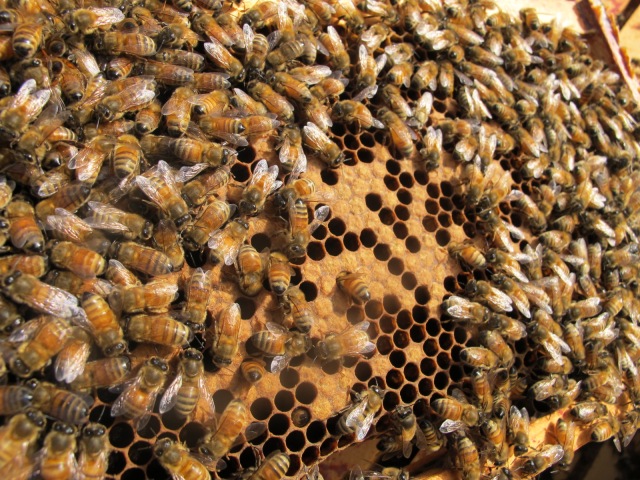
Honeybees complete foundation from a half-sheet

Half-Hung Foundation on a stronger hive

Honeybees complete a half-foundation frame at Brookfield Farm Bees And Honey, Maple FAlls, WA

A smaller hive’s work with half-hung foundation


Half-Foundation : Strong Hive.
Hive “A” for this post


Half-Foundation Somewhat smaller hive

Hive “B” for this post


Honeybees complete a foundationless frame in a Brookfield Farm hive.

Foundationless Frame in a stronger hive


Foundationless : Same Strong Hive As First Half-Hung Image

(Hive “A”)


Foundationless Beehive frame being worked by Brookfield Farm bees

A not-so-strong hive’s foundationless efforts


Foundationless : Same hive as first Foundationless Image

Hive “B”


2) Both types of frames were straight as can be – I attribute this to having drawn foundation on either side of each frame.  See above images.

3) The bees did draw out the Half-Hung frames faster than the foundationless.  See above images.

4) Foundationless frames were all drone-sized cells (many filled with honey).  See the second and fouth image above.

5) Half-Hung frames were worker-sized cells on top (where the foundation was) and drone-sized cells on the bottom.  It will be interesting to see if this influences the mite counts.  See the first and third image above.

6) Regarding points 4 & 5 : These frames are in positions 2 and 8, where bees tend to build drones.  (I shall drop some towards the center on a checker boarded hive soon, and see what that produces – the link is to a very nice explanation of how to checkboard a hive from Honey Bee Suite ).

Conclusion:

So far so good.  I’ll make up some more half-hung, and foundationless (if I have the time for the latter -  time and space needed for drying are a pain.

The Future:

It will be interesting to see:

1) If the foundationless and half-hung frames seem to have an effect of bee health.
2) If they have an effect on mite counts.
3) If the bees continue building them during a standard honey flow.
4) If weaker hives and nucs build on them.

I’ll let you know what happens.

Are you trying anything new this year?  If so do share what you’re doing and the results – it’s great when we can all learn new things together.

Also, if you have any words of wisdom about Foundationless or Half-Hung hives please share.  The good sides, the bad sides….

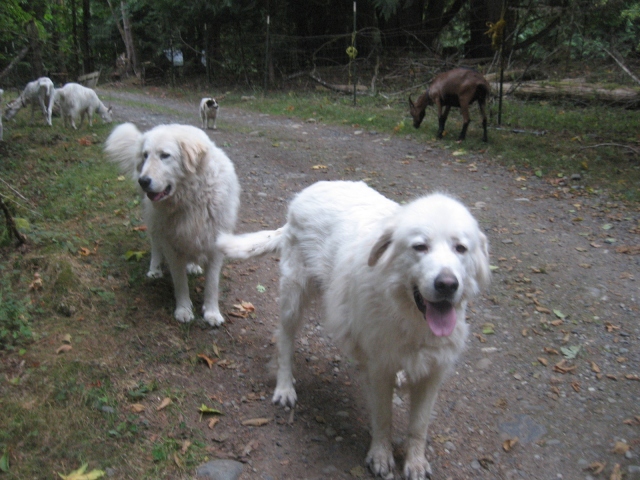
That’s the news from Brookfield Farm Bees And Honey – outside of the frames, I’m splitting hives, raising queens, doing farmers markets, and have brought in a Livestock Guard Dog Puppy, and three Muscovy Ducks (I’m new to ducks).  These latter came from my beekeeper friend Lisa at Round Tuit Farm Check out her farm – and honey – on her website and at her farmers markets.

Posted in 1 Beekeeping, 4 Hive Components | Tagged , , , , , , , , | 12 Comments

Preparing Supers for Bee Hives

I’m back – yes, I went away for 2 weeks:  5 days of driving and 7 days of hiking Paria Canyon in southern Utah.

Paria Canyon, "The Narrows" Southern Utah

“The Narrows” in Paria Canyon – the river is the trail

Before I left I had to do my spring chores:

Clean boxes and frames that I pulled from the hives in the Spring Cleaning.
Prepare supers to put on the hives that would need them while I was gone
Put those supers on the hives

Cleaning Boxes:

Hive Tool and Bee Hive Supers to be cleans

Ready For Cleaning

I take my hive tool with the wide curved end and remove any heavy wax/propolis build up.  I don’t get obsessive about it.  I just want a somewhat tidy environment for the new frames.

Scrape both top and bottom edges of the box
Scrape the indents where the frames sit
Scrape any wax build up on the inside of the box.

Sorting Frames:

Year numbers on the edge of bee hive super frames

Numbered by Year

All frames that have been used for 5 years in honey are out of the equipment.  All frames that have done only brood for 3 years are removed as well.  Frames that have done a bit of brood, a bit of honey, get put into honey rotation.  I don’t use queen excluders, so the queen puts brood wherever she wants to in the hive.

On cleaning I, again, just scrape off any big build-ups on the bars.

Preparing Supers:

Sometimes it seems like I’m doing a beekeeper’s version of the myth of Sisyphus.  For eternity, he had to keep rolling a stone up a hill, which would then fall back down, and then he’d push it up again.  With me in the spring it’s : clean boxes and frames, store neatly, then take boxes and fill them with the frames.

Frame Placement in Supers:

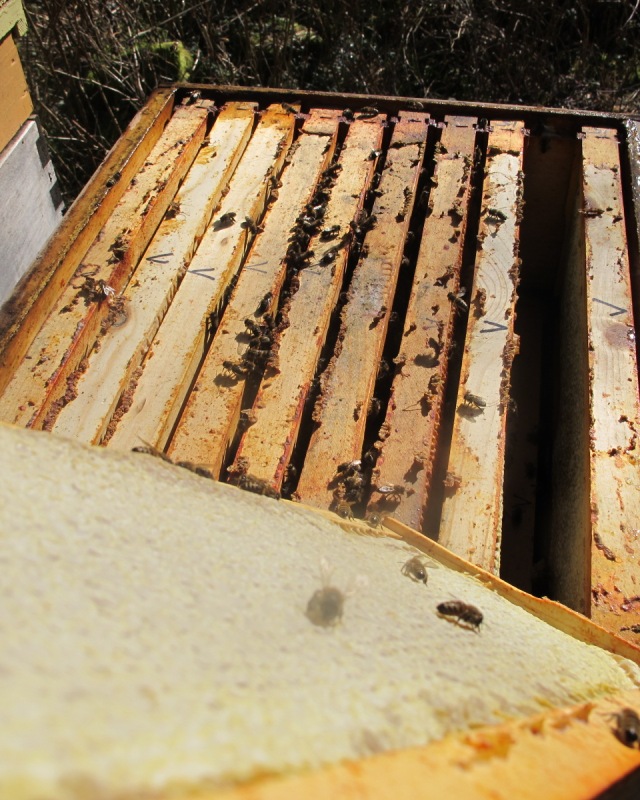
Frames for bee hives, in a honey super

Frames lined up in their super

Although my splits and supers are arranged differently, they get the same proportions of foundation to drawn comb – until I run out of drawn comb and go over to all foundation.  These are : 4 pieces of drawn comb.  6 pieces of foundation

The order in the boxes: (potions 1 to 10 going across the hive)

1 foundation
2 drawn comb for honey
3 foundation
4 drawn comb for brood
5 foundation

Then repeat in reverse order to the other side:
F, C, F, C, F

Placing Supers on Hives (aka The Method to the Madness)

Bee hive supers prepared for the bee hives

Supers Ready For Bee Yard

The above will (and should) seem a bit strange.  But there’s a reason.

When I put the super on the hive I:
Remove the center foundations (5 & 6) and set aside
Move the 2 center frames from the to-be-supered hive in positions 5 & 6 in the super
Put the foundations I removed in positions 2 & 8 in the lower box
Place the super on the hive.

When I come back to check the super in 2 weeks, if the box is being drawn out and filled, I will THEN frames 1 and 2 switch places, and 9 and 10 switch places.

In effect, I am working the box as an 8-frame box until that moment.  I find it helps to keep the comb to a uniform depth as they are drawn out.

Chores done – Off to hike.

Having completed all that, I jumped in my truck, drove to Utah and had a marvelous hike in one of the natural wonders of the world.  Next blog will be about that trip – I did see some bees….

That’s the news – admittedly a bit belated – from Brookfield Farm Bees And Honey.  How’s the honey flow going in your area?  Big Leaf Maples are still going here and the Cascara is about to bloom.

Posted in 1 Beekeeping, 4 Hive Components | Tagged , , , , , , | Leave a comment

Feeding Bees in the Spring

feedingfarmhives-1

I feed for three weeks in the spring, before the honey supers go on, and three weeks in the fall after the honey is harvested.  I feed cane syrup with essential oils.

Why Feed:

My spring feed has two components.

1) There is no forage from October to April in our area.  Although I leave about 70 pounds of honey on each hive, by March there is a good possibility of stores being very low.

This is especially true in a mild winter when the bees do not go into tight cluster and carry on eating their honey (the nerve of ‘um).  We just had a mild winter.  It’s the first year in a decade where we could drive to the farm every day.  Normally, for one to two weeks each winter, the snow is too deep to get up the hill to the farm even with 4-wheel drive, snow tires, and chains.    Mild winters are easier on me (no ¾ mile walks though the snow with groceries), but harder on the bees because they eat a lot of food and can run out by spring.

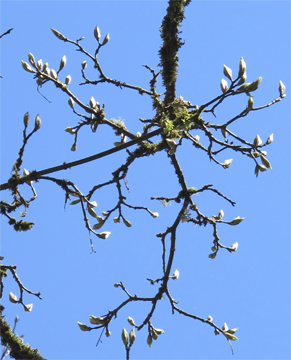
Big Leaf Maple Bloom

Big Leaf Maple Bloom
courtesy of Encyclopedia of Life

2) I want my bees to be building up by the blooming of the Big Leaf Maples.  These are our first major nectar source.  The Alders and wild Hazelnut trees have been providing pollen, but the Maples are the bees’ first sweet taste in the year.

Every year I write down when the flowers bloom (and when birds arrive, when green plants emerge, and the weather – good notes going back years are worth their weight in honey).  By my notes, the Maples should go into bloom around the second week in April.  Thus I need to start my up-river bee yard feedings in the third week of March.  The concept is build up, but no feed when the Maples bloom – so the bees will concentrate on them.

Of course nature does not follow humans’ plans, so I can be off by a week or two.  I had intended to start my down-river hives a week earlier than my up-river hives, but it rained for two weeks straight at that time.  I don’t open hives in the rain if it is not critical to do so.

I’m finally getting a chance to post this at the beginning of the second week of April.  I just finished the final feed on Friday.  That was the same day that I saw my first up river blooms of Big Leaf Maples. So, a week earlier start would have been better (but it had rained for 2 weeks at that time).

Up-River / Down-River an explanation:

I keep bees along a west to east corridor in the most northwest county in Washington state.

800px-North_Fork_Nooksack_River_from_Mosquito_Lake_Road_BridgeThe route falls pretty much along the North Fork of the Nooksack River.  The down river (westerly) bee yards see spring at least a week earlier than my up river (easterly) bee yards.


3-Wire bear fence protects Brookfield Farm bees at Spring Frog Farm, Bellingham, WA

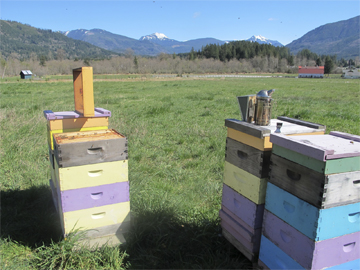
Hives at Spring Frog Farm (down river bee yard)

The down river yards are in berry country – Whatcom county is the largest producer of Raspberries in Washington state, and Washington state is the largest producer of raspberries in the US (according to the internet).  The up river yards are in mountain wildflower country.


Bee hives at Brookfield Farm, spring 2012

Up River Bee Yard


The road along the river turns about 10 miles up river from my last bee yard and climbs to Mt. Baker, the second most glaciated mountain in Washington.


Have I mentioned how beautiful it is here?

Upper Northfork of Nooksack River, winter, near Brookfield Farm, Maple Falls

a few miles up river from the farm


Back to Feeding: The physical part:

Hive Top Feeder : Home made. Brookfield Farm Bees And Honey, Maple Falls, WA

Feeder after bees have dined.

1) Remove the insulation that has been on the burlap that’s on the top bars.

2) Place a “dollar store” hive top feeder on the top bars. This is a plastic container in which I place thin pieces of wood. They are set in two layers, at right angles to each other.  Think “raft” and you have exactly what I’m doing.  The containers are from the local “Dollar Store”.  The cut wood is off-cuts of my husband’s furniture making

3) The burlap is folded over and placed next to the feeder – it acts as a ramp to the feeder

4) I add the feed.

What I Feed:

I started with a recipe I found on line; then over the years, made changes.  Nothing, I repeat nothing is scientifically tested – this just seems to work for me.

The Recipe I Use:

The following is based on making a pot of feed that produces 3.5 gallons of feed.

The pot I use is a four-gallon cook stew pot (if someone can explain the discrepancy to me, between the full 4-gallon pot and resulting 3.5-gallons of feed, please let me know.  I’ve always wondered).

½ pot of water
½ pot of cane sugar
1 teaspoon organic soy Lecithin (dry) – this is an emulsifier
2 ¼ teaspoons Lemon Grass Oil
1 ½ teaspoons Spearmint Oil
¾  teaspoons Tea Tree Oil
1 ¼ teaspoon Thyme Oil (Thymol)
Bring water to boil on stove.

While water is boiling:
Dissolve lecithin in 1/4-1/2 cup of boiling water – stir until dissolves
Add oils, stir.
Set aside

Take boiling water off stove:
Remove and let cool a bit – cold rooms, less time than warm rooms.
Add sugar – Stir until dissolves (usually the length of singing “Aupres De Ma Blonde
Add cup of essential oils, lecithin and water.

Stir.  Let cool

If another batch is to be done: RINSE OUT THE CUP THE OIL WAS IN BEFORE STARTING AGAIN – other wise the lecithin won’t dissolve as well (took me ages to figure that out).

I do 3 pots at a time, and make just over 90 gallons of feed each spring and fall.

All Fed – Trees in Bloom

Big Leaf Maple Buds

almost ready to bloom

I’m writing this just as I have just finished all the feeding. Some bees are chowing down heavily, some are eating at a steady pace, and some are ignoring the feed.  Happily, most hives have lots of honey left from last year – and no matter what I feed them; their honey is the best thing they can eat.  Best yet, we’re about to go into 3 to 4 weeks of Big Leaf Maple Bloom, followed by vine Maples.  Now if it would just stop raining (yes the rains came back, as they always do here).

That’s the news from Brookfield Farm Bees and Honey. Do you feed?  If so, what do you use?  I learned about Tea Tree Oil from another beekeeper.  Another friend is experimenting with putting stinging nettles and dandelion leaves in the syrup water (I’m very interested to see how that goes for him). Beekeeping’s all about constant learning and evolving – the bees don’t stop changing, so we need to change with them.

Posted in 1 Beekeeping, 4 Feeding Bees | Tagged , , , , , , , , , , | 6 Comments

Spring Hive Manipulation

Brookfield Farm Bees in the Spring (Maple Falls, WA)

Happy Bees in Sunshine!

It’s spring (ok, four days of sun, we take what we can in the Pacific Northwest).

In the spring, I manipulate my hives.  At least that’s what I call it.  I think the bees think “oh no, she’s messing with our home!”  But it needs to be messed with.  Bottom screens need cleaning (and weeding at times).  Empty bottom boxes need to be move to the top.  The brood nest needs to be moved down, so the bees won’t swarm.

I try to do this on the first feed of the year.  This year, that first feed was done under stormy skies, so I did not want to open hive only to have it rain.

Thus, hive manipulation was moved to week number two of feeding, when the sun came out.

Winter Set Up (in brief)

All my bees are in mediums (aka westerns).  So I use more boxes than those folks who keep bees in deeps.

A tall bee hive of medium boxes

Stack of boxes I call hive (there’s a nuc on top)

Bottom Screen : I don’t use a solid bottom, just a screen of 1/8th inch hardware cloth
Bottom box: is pollen – that’s where the bees put it in fall.  That’s where it stays.
Next box up: brood
Next box up: brood (if there’s that much) or honey
Next box up: honey
Next box up : honey (if there were 2 boxes of brood and that much honey)
Collar – a 2 inch high frame the same dimensions as the hive boxes.
Burlap over the top bars
Insulation on the burlap

You can read more about how I prepare winter hives on this blog page


Spring Traditions (at least to the bees):

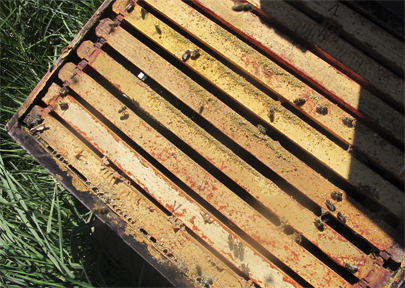
By April the bottom box is empty.  The bees have eaten all their pollen either in the fall or the spring (I don’t ask about the timing, they don’t tell).  If I find pollen left, it’s usually a hive with a problem: a failing, or failed queen.

When all is right, the queen and brood can be anywhere.  Sometimes they’re in the top box.  This is worrying, as they’ve eaten all their food.  Sometimes they’re in the second or third box.

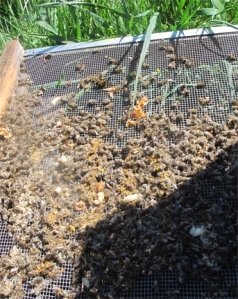
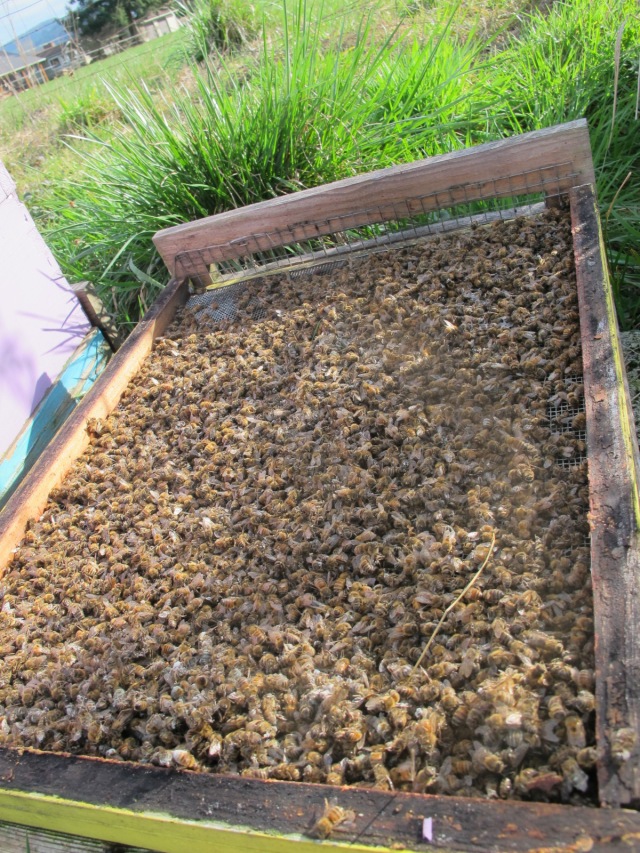
The bottom screen is usually covered with the dead bees of winter.  By November it is too cold to break cluster and the bees just drop the dead to the bottom of the hive.   These need to be piled up and removed from the bee yard.

Bottom of bee hive before Spring Cleaning

The Dead of the Winter


Spring Movements:

In General:

The bottom screen is cleaned of dead bees and put back in place.

Any empty frames that have been in use for five years are removed.

Any brood frames that have been in use for three years are removed.

These are replaced with either drawn comb or foundation.

The empty bottom box is removed.

If an empty box is needed on top, it will find a new position there.

Bee Boxes being removed for spring cleaning

Empty frames and boxes


Specific Spring Manipulations:

1) The bottom screen is cleaned of dead bees, old pollen, and grasses that may have grown through the screen.
2) The box with eggs (and probably the queen) is moved to the bottom.
3) Any box with sealed brood is placed above it.  As the brood emerges, this will give the queen room to lay.
4) Any box(es) with honey are placed above the brood, with a eye to leaving the queen laying room
5) If the “honey” box is pretty full, and empty box goes on that.  If there is no, or very little, honey, the empty box goes above the brood.

Folks who over winter in 2 deeps will recognize the system as : put the top box on the bottom, and the bottom box on top.  It’s just more complicated with mediums.  But I can lift them.

Nice thing about mediums:

The nicest thing is that I can lift them.  But there’s another nice aspect if you live in a land of rain, as I do.  The lowest box can get manky – damp, even with ventilation and a screened bottom.  Wet just gets in everything around here.  But with a stack of mediums, the bees are far away from the damp lower box by spring.  At least mine are.

Spring : with a fine tooth comb

I only have about 50 hives.  So that lets me take a good look at my hives in the spring, and I take that time.  I check for diseases, for queen laying patterns, the queen’s existence (and if none, eggs are given to the hive), and, of course, stores.  It can leave you wondering if you can purchase a new back, but it’s worth the time and effort.  I keep notes on everything.

This spring’s results:

I lost 2 hives and one nuc.  That’s less than a 5% loss so that’s good.  Of course, spring’s around the corner, and this area is hard on bees in the spring.

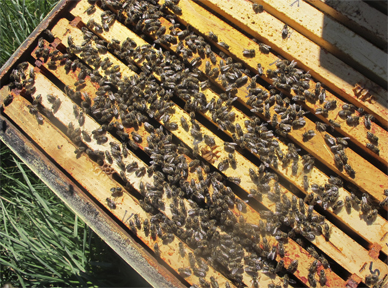
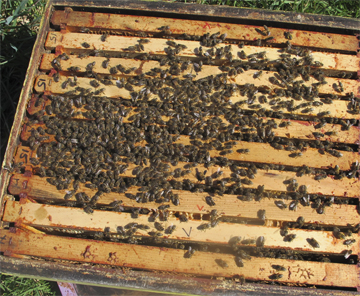
Two hives had brood, but no eggs – either a failing queen or a lost queen.  These have been given eggs with which to build new queens.

On hive, which was 3 failing hives tossed together with “let the best queen win” came out OK.  The “best queen” – or most adaptive – and her group moved to one side of the hive and came though the winter just fine.

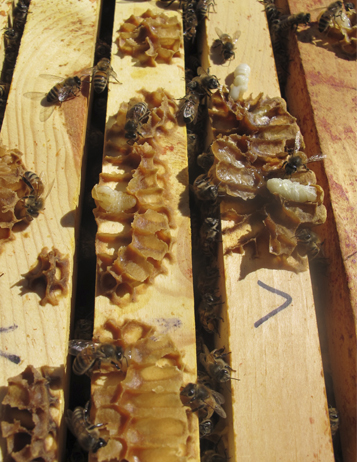
The 2 hives that went down showed failed queens.  I am suspicious of 3 hives that are doing well – empty frames looked like American foul brood scales.

AFB scale photo from Fera, UK

American Foulbrood Scales (photo Courtesy The Food and Environment Research Agency (Fera), Crown Copyright

Samples have been sent to the Maryland Bee Lab.  But the check this week (the third week) shows no sign of AFB.  We shall see….


Report on Winter Experiment : Not Wrapping Hives.

Bee hives tied and covered for winter

The new way

This is the first year I have not wrapped my hives in tar paper.  Remember, this was a mild year here – it just rained all the time, not much snow after January.

The hives STAYED JUST AS DRY OR DRIER WITHOUT THE WRAP.  Big letters because I’m so amazed and pleased.


Strong hive below nucleus hive wrapped for winter

The old way (hive and nuc on top)

I will no longer wrap hives.  I will be forever grateful to the Liam (whose last name I cannot remember) of the Mt. Baker Beekeeper Association for gently suggesting I might try not wrapping.  It was just fine for the bees, and saved me a lot of work.


That’s the news from Brookfield Farm Bees And Honey.  How did your bees come though the winter?  Any new techniques you tried that worked (or didn’t work)?  Beekeeping’s all about sharing and learning.

Posted in 1 Beekeeping, 8 Brookfield Farm & Bees | Tagged , , , , , , , , | 2 Comments

American Foulbrood Researchers – The Few, The Committed

If you’ve been reading this blog for a bit, you know that I’ve had run-ins with American Foulbrood (AFB) for two years in a row.

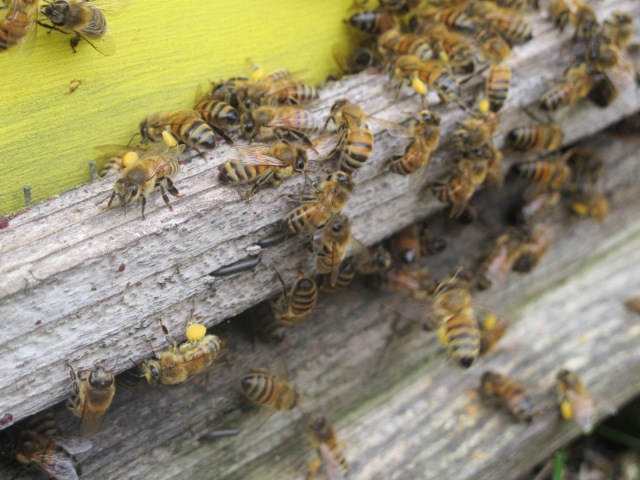
Honeybees at Brookfield Farm Bees and Honey, Maple FAlls, WA

Brookfield Farm Bees at Top Entrance

I run naturally treated, antibiotic-free hives, in which I eliminate with the elimination of all comb over 5 years old, and old brood comb over 3 years old.  But AFB still appears – once it’s in an apiary, it is hard to get out, short of removing all drawn comb.   The spores can live 40 years.  I got fed up last year and removed all unoccupied brood comb, regardless of age (it is painful to destroy comb that has only been drawn out for a few months, believe me).


Time For A Natural Change?

When AFB hit the only solution was to do what has been done for over a century: kill the bees in those hives, burn all frames, and scorch the rest of the gear.  In both years AFB turned up in the fall, so shaking the bees onto undrawn foundation was not an option: there’s nothing with which the bees can drawn comb from October to April.
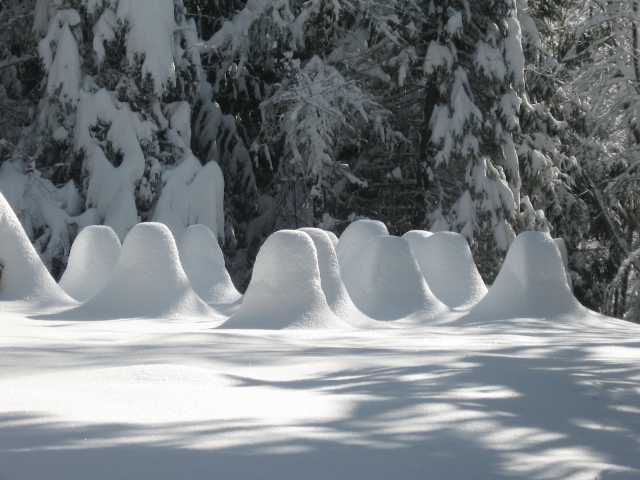
All that killing and burning – techniques that inspired me to go on a world-wide search for research being done on ways to fight and hopefully kill the AFB spores without destroying the hive.

Technology Schematic 1916

Technology 1916 (wikipedia commons)

A century has passed since American Foulbrood was identified as a unique honeybee disease.  In that time we went from the first AM radio transmissions to ships at sea to smartphones; and from speculation about the existance of vitamins in food to mapping DNA.

I figured there must be someone in the world working on finding a natural way to fight these tough bacteria with 21st century methods.

The Dedicated Few

Happily I found two groups.  Yes, two. That’s all, but they are there.  This makes me:

  • Pleased : that these folks are working on fighting American Foulbrood with natural substances.
  • Shocked : that there’s only two groups that I could locate

Las Vegas : Home of US American Foulbrood Microbiology Research

University of Las Vegas, Nevada Sign

University of Las Vegas, Nevada

OK, AFB is not what I think of right away when I think of Vegas – my mental image strays more towards Hunter S. Thompsons’ “Fear and Loathing“.  But environmental microbiology student Diane Yost and microbiologist Professor Penny Amy are undertaking AFB research at the University of Nevada, Las Vegas.


Working under a grant from the US Department of Agriculture, Yost and Amy are looking at the potential of fighting the AFB bacteria (Paenibacillus larvae) with bacteriophages.  A bacteriophage is a parasitic virus that infects bacteria then reproduces inside of it, killing the bacteria.  (I love these little phages) This “virus kills bacteria” concept is being tested on other bacteria which have become resistant to antibiotics.

Microbiology image from Gulf Breeze Laboratory

Microbiology In Action


Yost and Amy began by testing over 100 differnet types of samples from dirt and flowers to beeswax to lip balm, looking for beeswax with AFB and bacteriophages.


  • They found 31 phages.
  • They tested those on 8 strains of American Foulbrood bacteria
  • 3 naturally occuring bacteriophages showed promise against all 8 AFB strains.
  • If further research shows them to be able to infect and kill AFB bacteria, that would be the first step in the search for a natural treatment for American Foul Brood.

Yes, all the above just gets to the first step.  The work is quite complicated and challenging

  1. Yost and Amy are attempting to locate molecules that would cause AFB spores to germinate at the wrong times, which would then lay the spores opens to attack by enzymes that would tear apart the bacterias’ cell walls.  Those enzymes would be produced by the bacteriopages.
  2. Step two would be to isolate and use natural compounds and amino acids found in adult bees  to protect the honeybee larva.

The goal, writes Yost, is to create “treatments that can protect bees as well as remove the infectious spores from the hive without the risk of resistance posed by current antibiotic treatments or contamination of the hive and its products.”

You can read more about theire work in a paper they preesnted last year at the General Meeting of the American Society for Microbiology.

York, U.K. :

Food And Environmental REsearch Agency, York UK logo

FERA, UK

At the Fera National Bee Unit and the University of York, researchers are looking at ways of controling AFB by looking at how the disease spreads.  “the underlying philosophy is to understand how outbreaks spread. The idea is that better advice to apiarists should result in fewer outbreaks, and colony destruction becomes the last resort treatment,” explains Professor Thorunn Helgason.

Part of their research focuses on the genetic diversity of AFB bacteria found in Europe and how that diversity affects the spread of the disease.  One graduate student at the University has designed a genetic marker system that will allow researchers to more easily differentiate and follow strains of AFB.

German AFB Research in 2008

I did find references to American Foulbrood research being done five years ago by Professor Elke Genersch, a microbiologist working in Berlin.  Professor Genersch and collegues discovered that the AFB bacteria replicate in the midgut of the bee larvae, where they live off the food eaten by the bee larvae. The bacteria increase in number until they completely fill the gut.  Then they explode out of the gut, expand though the cavity that contain all the larvas organs.  This kills the larva.  The resulting goo is ridden with bacteria spores.

This work is part of the basis on which todays work is being done.  I tried to contact Professor Genersch, to discover what work has subsequently been done, but I failed to connect.

HEARTFELT THANKS TO THE RESEARCHERS

Scientific research takes a long time.  Results have to be examined and replicated.  So although a natural treatement for American Foulbrood is probably not just around the corner, it is good to know that some people are working on alternatives to killing bees and burning equipment or to the continuous development of new antibiotics to which the bacteria soon become resistant.

A NOTE ON THE ANTIBIOTICS USED FOR AFB

We are now on what I think is the fourth antibiotic used against AFB in the United States.  Many countries have banned the use of antibiotics in beehives.

  • Antibiotics stay in the hive, with the bees, their pollen, and their honey.
  • Antibiotics do NOT kill the AFB spores.
    If continuous antibiotic use stops on a hive, AFB will florish and kill the hive
  • Antibiotics only serve to allow infected bee larva to survive.
  • Antibiotic treated hives are potentially filled with viable AFB spores.
    These spores can be passed on to other hives through drone visits and robber bees.
    These spores, on reaching another hive, will replicate and kill that hive.

Hope For the Future

Honeybee with lots of pollen : Brookfield Farm Bees And Honey, Maple Falls, WA

Happy Honeybee

There is hope that one day there will be a natural treatement to combat American Foul Brood.  It won’t be tomorrow or the next day, and it will take a lot of dedicated scientific study to find that treatment.  I, for one, am very greatful to the researchers who undertake this work.  Their work could one day bring an end to a disease that has threatened honeybees for over a century.

That’s the news from Brookfield Farm Bees And Honey, Maple Falls, Washington.  We’ve had a few nice days where the bees flew, and lots of rainy, overcast days where they stayed in.  I’m hoping for a good spring – with the Big Leaf Maples coming into bloom in about one month.  In the meantime, it’s just good to see the girls fly in our brief moments of sun.

Posted in 1 Beekeeping, 2 Diseases/Pests/Treatments | Tagged , , , , | 6 Comments

Storing Drawn Foundation at Brookfield Farm

Spring usually is not the time to contemplate how to store frames of foundation, but I was asked about this recently.  In addition, I was just hanging up some drawn, empty frames that once contained honey, which my bees have eaten.

HANGING FIVE, or five hundred

How foundation is stored at Brookfield Farm, Maple Falls, WA

the line on the right is 40 feet long.

I favor the “under cover in the open air approach”.  My drawn frames of foundation are hung on long flat pieces of thin wood that are suspended from the rafters of my 40-foot barn’s hayloft.  My not terribly high tech approach was to hammer nails into the rafters, then suspend bailing twine down to the wooden holders.

These hang from September to at least April.  This means long periods of rain, snow, and sub-freezing weather.  But the frames are always under cover.

I have never had wax moths using this method.

Bailing twine was the suspension method chosen because I have goats, which eat copious amounts of hay.  Thus I have copious amounts of bailing twine.

The long pieces of wood are by-products of my husband’s furniture making.


Little “Tunnels”

Time is always of the essence.  If I run out of space on the overhead hangers, and have no time to create more, I go for the “three deep tunnel of frames” method.

Alternate way to store drawn comb foundation, at Brookfield Farm, Maple Falls, WA

3 “tunnels” of 3-deep foundation

Boxes of drawn comb are stacked on end three deep.  Another three can go on top, and on up the roof.  The idea is never to go deeper than three in a stack.   Normally, the sides of these boxes sit against a stack of empty boxes or the wall of the barn for stability.  Always the solid side of the box, the open sides are left open.

I learned this in an old issue of Bee Culture.  That beekeeper suggested putting 1/8th inch hardware cloth on each end of the little “tunnel”.   I believe this was mainly to keep mice out of the boxes.  I have cats.  I don’t have mice.  Cats are easier than building frames, in my humble opinion.

Like the above method, this allows for light and air to reach the frames.

Air and Light

Both methods depend upon air and light.  Wax moths, it would seem, greatly prefer to lay their eggs in dark, safe places.

In the over ten years of using the hanging method, and two years of additional little tunnels, I have never had wax moths in my stored frames.

Hanging Out All Year

Although late fall is the usual time for me to be hanging frames; as I said, I just got done hanging up frames pulled from empty boxes.  It’s the time of year here to assess the hives coming out of winter and prepare them for spring.  That always leaves me with a few empty boxes that need to be stored before they go on again in the spring.

That’s the news from Brookfield Farm Bees and Honey, Maple Falls, Washington – I hope your spring bee chores are bring you good news from your hives.  Do you store boxes without moth crystals?  If so, what method are you using?  I’m always up for new ideas.

Posted in 1 Beekeeping, 4 Hive Components | Tagged , , , , , , , | 2 Comments